
Project Architecture Overview
Project Architecture Overview
Before diving into individual components, let’s take a step back and look at the overall architecture powering the Mood-Based Music Recommender chatbot.
This project uses a modular, serverless architecture built on AWS, with a clear separation between the UI, conversational engine, and fulfillment logic. It showcases how to build scalable, event-driven applications using modern cloud-native tools.
🔧 Architecture Diagram
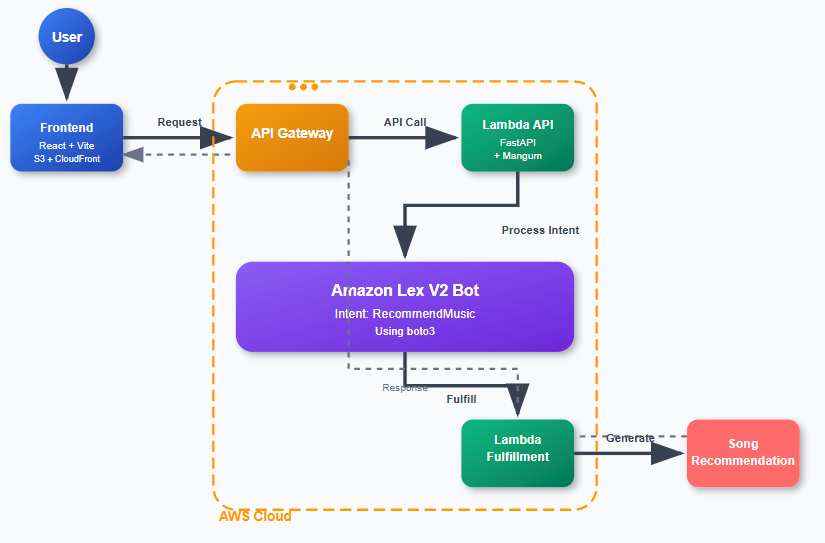
🧩 High-Level Overview
Here’s how the system is structured:
-
Frontend (React + Vite)
- A responsive single-page application built with React and Vite.
- Hosted on Amazon S3 and served via CloudFront for global availability and fast performance.
- The frontend presents the chatbot UI and interacts with the backend API to communicate with the Lex bot.
-
Backend API (FastAPI + Lambda)
- A FastAPI application wrapped using Mangum, deployed as an AWS Lambda function.
- This API acts as the middle layer between the frontend and AWS Lex.
- When a user sends a message, the API uses
boto3to invoke the Lex bot and retrieve a response. This approach allows custom logging, validation, and integration hooks around Lex interactions.
-
Conversational Engine (AWS Lex V2)
- The core chatbot is built with AWS Lex V2.
- It handles natural language understanding — detecting intents (like requesting a song) and extracting relevant slot values (e.g., user mood).
- The Lex bot is intentionally kept simple with a single intent and slot for focused, effective interactions.
-
Fulfillment Logic (AWS Lambda)
- Once Lex recognizes the intent and slot, it triggers a fulfillment Lambda function.
- This function processes the user mood and returns a song recommendation.
- In the future, this logic can be extended to include dynamic sources like music APIs or personalized recommendations.
-
Infrastructure as Code (AWS CDK)
- The entire infrastructure — including Lex bot, Lambda functions, API Gateway, S3 bucket, and CloudFront — is provisioned using AWS CDK in Python.
- This enables repeatable deployments and version-controlled infrastructure changes.
-
Version Control (GitHub)
- All code and infrastructure definitions are maintained in GitHub, making collaboration and CI/CD integration easier.
🔄 Request Flow
Here’s how a typical request flows through the system:
User → React Frontend → FastAPI (Lambda) → AWS Lex (via boto3) → Fulfillment Lambda → Response → Frontend UI
This design ensures:
- Full control over the Lex interaction lifecycle via the API.
- Clean separation between the frontend and business logic.
- Serverless scalability and low cost for low-to-medium traffic workloads.